
Freedom - what does it mean to you?
For me, roaming natural landscapes is a beloved freedom, offering respite from London’s hurly-burly, so it was a moving experience to wander the Kent countryside whilst hearing the stories of people with lived experience of immigration detention.
The roots of the word freedom are tangled with words meaning love, possibly to distinguish between beloved kin and slaves or staff. Xenia, the love of strangers, was the ancient principle of hospitality, essential for maintaining the freedom of movement and peaceful relations that forge happy travellers’ tales. Xenophobia, the fear of strangers, underlies dehumanising narratives about ‘foreigners.’ Removing a person’s freedom is one of society’s most primal forms of punishment, signalling that they are unloved and unwelcome.
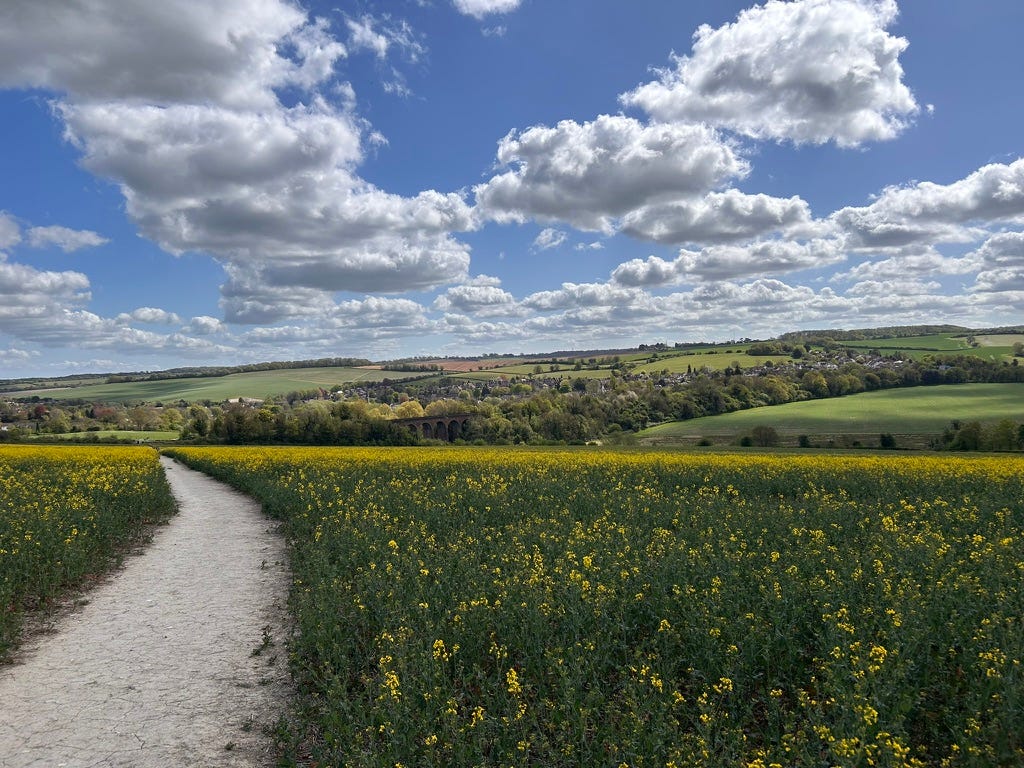
Image: Eynsford Viaduct within a vista of fields
Refugee Tales walks show solidarity with people in immigration detention, building friendships and community whilst being in nature. In the style of Chaucer’s Canterbury Tales, their annual 5-day festival, attended by 120 walkers, includes sharing songs and stories.
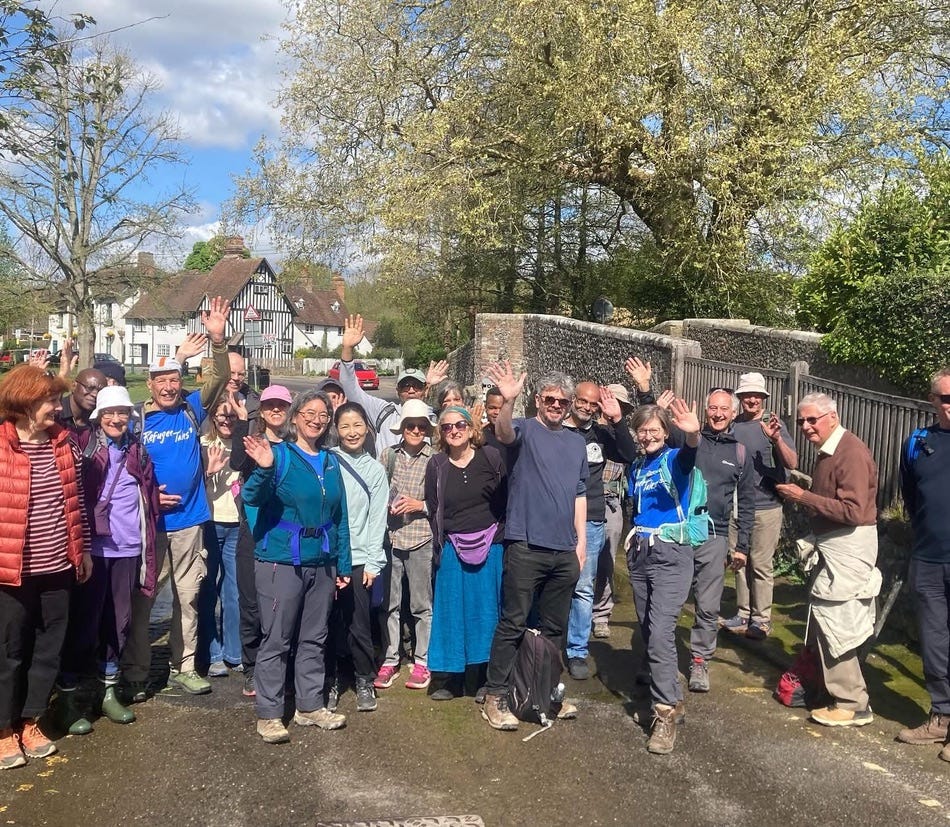
Two years ago, ’s wonderful Southwark walk marked the starting point of Chaucer’s journey along The Pilgrim’s Way to Canterbury. Last weekend, I joined a walk from Eynsford to Otford, another chapter of the Way, rambling through sunsplashed fields, trinkety villages and burbling riverbanks, whilst listening for the stories riding the April breeze.
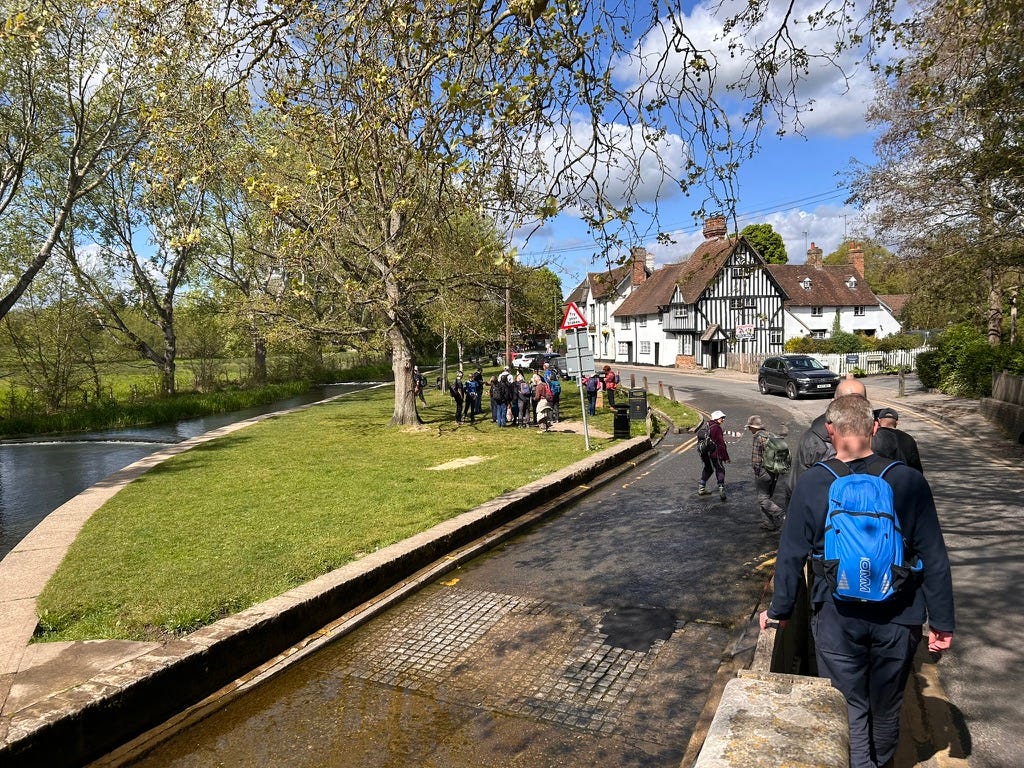
Image: Eynsford
Crossing the ford at Eynsford, we charted our way through bright canary rapeseed fields, the 9-arched, 75-foot Victorian viaduct nestled within a rolling panorama. Expertly guided by Gordon, with Phil tracking the tail and watchful walkers sounding warnings: ‘car! bicycle! train!’, our friendly group was in safe hands.
Historical tales bubbled up as we traced the borders of Lullingstone Roman Villa and Lullingstone Castle, whose 20th-generation owner, Tom Hart Dyke, designed his World Garden whilst held captive in the Panamanian jungle. After a photo stop at the Castle jaws, we caught sight of its sparkling lakes glinting through the green banks of the Darent River. Having picnicked at Lullingstone Country Park, we passed the pale lilac promise of Castle Farm Lavender Farm, preparing to burst into bloom, and a group of snoozy cows sunning themselves amongst Kent’s famous hops.
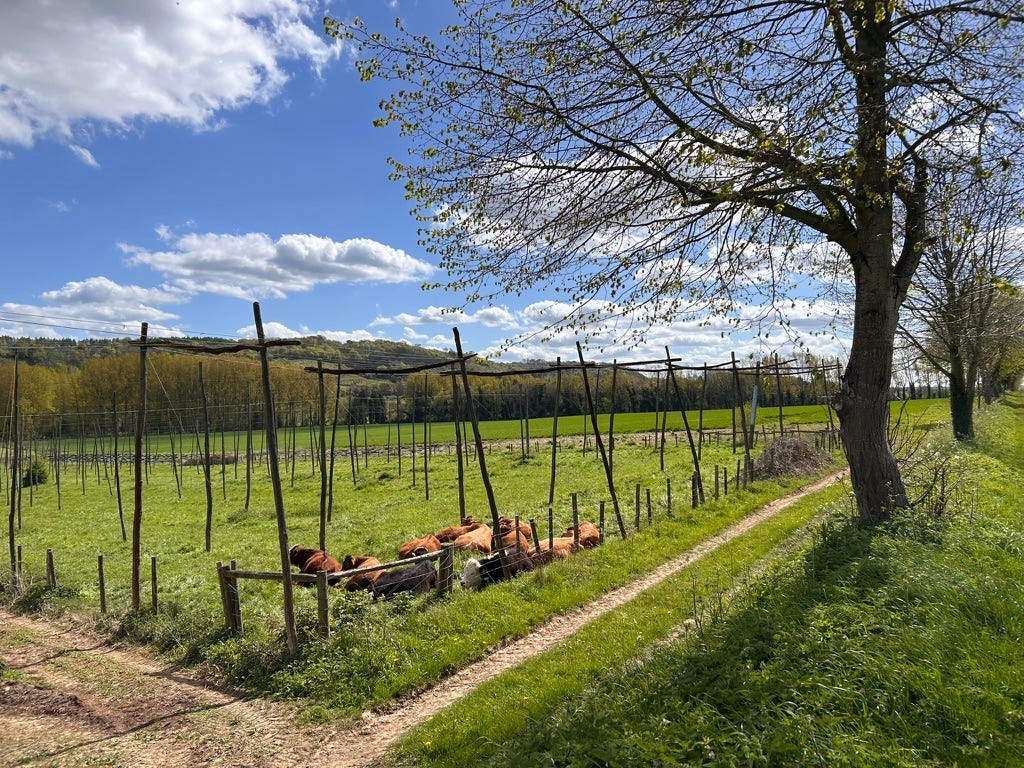
Image: Hops are notoriously snooze-inducing.
Arriving in Shoreham, we loitered at artist Samuel Palmer’s gates, a leading light of The Ancients, a group of William Blake aficionados. After pausing for welly-wearers to paddle in the river, a contemplative moment in the Norman church prompted walkers’ tales of nights camping out in churches during the annual 5-day walk. Having escaped the chorus of snorers to sleep outside, one walker awoke to find he was covered in starry snail trails.
We made a galactic entry to Otford via a gap in the hedge by a pillar representing Saturn in the Otford Solar System, which maps our planetary neighbours at a mind-boggling scale of 1:4,595,700,000 (1mm = 4,595.7km). Beyond the country’s only listed duck pond, a friendly guide filled in the ruined gaps of Otford Palace, built by Archbishop of Canterbury William Warham to rival Hampton Court in 1515.
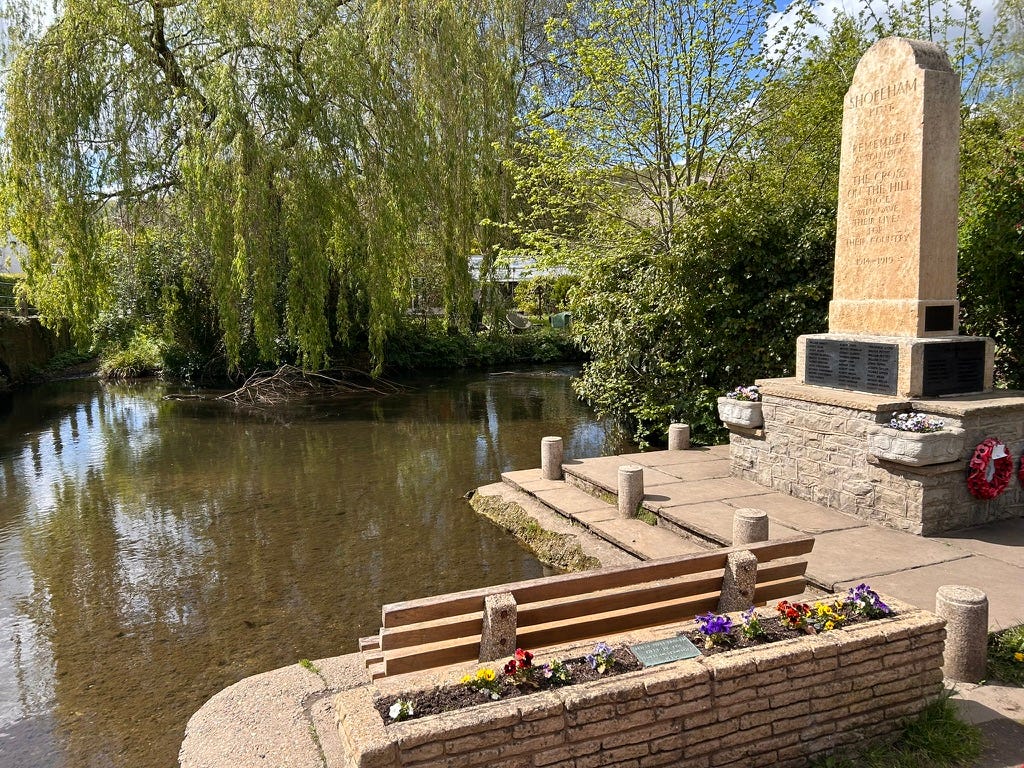
Image: Shoreham War Memorial by the river Darent
Amidst the monumental tales of historical elites, the tales of my fellow walkers hit home. “They treated me very badly,” says one walker, who was deeply affected by being detained for three months. A business professional currently housed in hotel accommodation, who has been waiting over a year for a decision on their asylum case, described feeling hopeless and frustrated at being unable to live independently and contribute to society. These human stories are rarely told in the political power play of mainstream media.
For one advocate at Gatwick Detainees Welfare Group, which runs Refugee Tales, listening to detainees’ stories with an open, accepting ear is a vital part of restoring trust. After hearing how private companies are funded by taxpayers’ money to run detention centres at great profit, the penny literally drops that we are all implicated, prompting me to research the gruelling political timeline of detention (below).
‘Doing time’ is a phrase we reserve for prisoners, and whilst the vast majority of detainees are not criminals, they are treated as such, and kept in dehumanising conditions without any clear timelines for release. As walking is a way to mark time, Refugee Tales walk for a future free of immigration detention, a future we all need to step towards.
A Timeline of Detention in the UK
Before 1962 - anyone living within the British Empire/ Commonwealth had the right to enter and remain in the UK. Immigrants registered their home address with the police and had to demonstrate they were fit and able to support themselves.
1962 - Commonwealth Immigrants Act - ended free movement for Commonwealth subjects. Only those with work permits could enter the UK.
1968 - Commonwealth Immigrants Act - British citizens were defined as those born or those with a parent/ grandparent born in the UK, or those resident for more than 5 years.
1970 - The first Detention Centre was opened in Harmondsworth
1971 - Immigration Act - gave the Home Office the authority to detain people indefinitely on arrival in the UK whilst awaiting a decision or deportation.
1999 Immigration and Asylum Act - formalised detention centres as part of immigration administration, rather than a short-term crisis measure.
2001 - Detention centres were renamed Removal Centres
8 Removal Centres have been established in the UK, mostly run by private companies, who make 20%- 40% profits, whilst using detainees’ labour.
2014-16 - Immigration Acts introduced the ‘hostile environment’ policy, ensuring that those without legal status could no longer seek employment, open bank accounts, rent homes, gain driving licenses, or appeal their cases.
2012-2015 - The Home Office paid almost £14 million in compensation following claims for unlawful detention.
2015 - Detention rates reached an all-time high of 32,447
2015 - The first cross-party parliamentary report on detention concluded that “we detain far too many people unnecessarily and for far too long. The current system is expensive, ineffective and unjust.”
2017 - BBC Panorama investigation - Callum Tolley, a detainee custody officer, filmed undercover footage of the conditions at Brook House Removal Centre, resulting in the suspension of 10 members of staff.
2018 - A Guardian survey of detainees found that 56% were at severe risk, with two suicide attempts made per day.
2019 - A child trafficking victim detainee won £85,000 in compensation after he was sexually assaulted and illegally detained at Morton Hall, which was previously a welcome and reception centre, before becoming a Removal Centre in 2011
2019 - The UK government refused to implement a 28-day limit on detention recommended by the Joint Committee of Human Rights.
2024 - Harmondsworth Hall Report - detailed increased violence and drug-taking, and that 75% of detainees felt unsafe, and 50% felt suicidal.
2025 - 22,671 people were held in immigration detention.
In September 2025, 17,000 people had been waiting over a year for a decision on their asylum cases, as part of a huge backlog.
With thanks to: Anna Sayburn Lane, Gatwick Detainees Welfare Group and Refugee Tales
